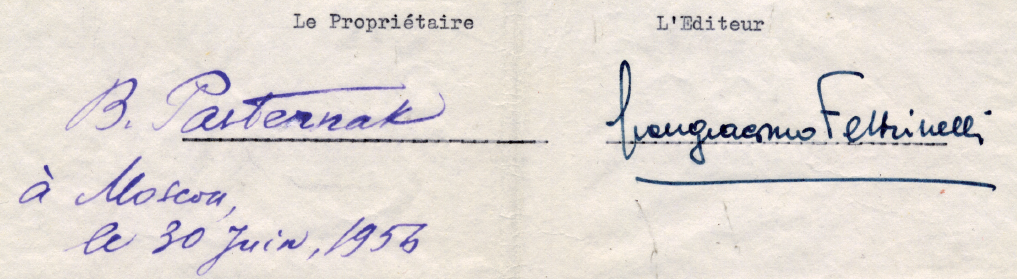
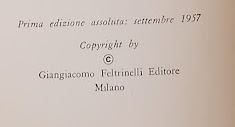
The publication history of Doctor Zhivago continues to deliver pleasant surprises. In the winter of 2024 I was contacted by Giacomo Coronelli (see my previous post on the Libreria Antiquaria Pontremoli and the translation of my book Smugglers, Rebels, Pirates into Italian) who alerted me to a remarkable copy of Doctor Zhivago that had recently arrived at the Libreria Antiquaria and publisher Pontremoli where he worked as senior rare book dealer and catalogue book designer and editor. The volume in question is a bound copy of Il dottor Zivago in Italian with the peculiarity that the colophon says “First absolute edition: September 1957” (“Prima edizione assoluta: settembre 1957”)
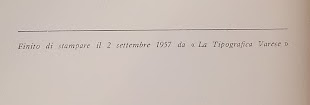
and the final page reports “Printed on September 2, 1957, by La Tipografica Varese” (“Finito di stampare il 2 settembre 1957 da “La Tipografica Varese””).
Given that the first Italian edition of Doctor Zhivago has November 15, 1957, as publication date, the finding is of the highest interest. Indeed, it is an absolute first. I have been looking at first editions of Doctor Zhivago for more than fifteen years and I had never come across such an edition. Moreover, as I am familiar with the correspondence surrounding the translation of the novel (by Pietro Zveteremich) exchanged among Feltrinelli, Zveteremich and the other members of the Feltrinelli editorial team in charge of the production of Doctor Zhivago (Brega, Riva, Diemoz), I can with confidence say that nowhere in these documents there is a reference to an advance copy of Il dottor Zivago. However, these documents are useful for placing this edition in context and we can use them to explain its peculiarities. I will refer to this edition as the Ur-Edition, simply to distinguish it from the first edition and the successive ones.
External differences between the Ur-Edition and the first edition.
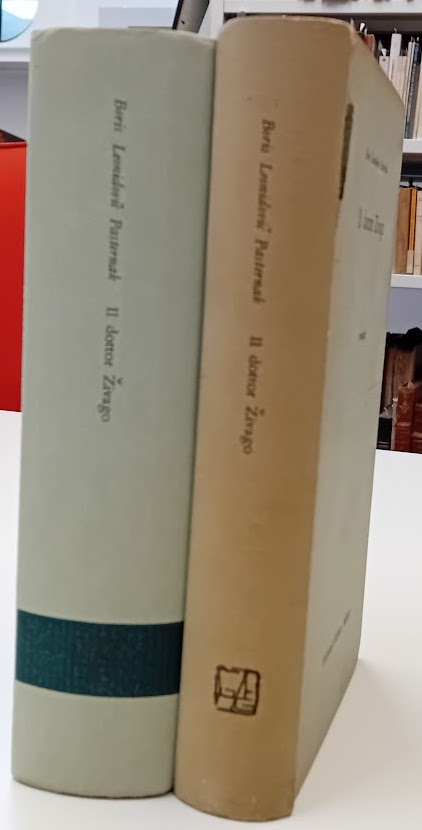
The measurements of the Ur-edition are slightly different from those of the first edition (see picture below showing the different heights). The Ur-Edition has 673 pages (plus a page with the information about the date of printing and the printer). The first edition has 712 pages. The version that is now in the hands of the Libreria Antiquaria Pontremoli does not have a dust jacket and it is quite likely that it never had one. The punctuation of Boris Pasternak’s name appears as it does in the first edition (i.e. with dotted i’s and without diacritical signs except on the c: Boris Leonidovič Pasternak).
An interesting difference with the first edition is that the back of the Ur-Edition has a Feltrinelli logo rather than the green band (with logo) present in the first edition.
Finally, the covers have different colors: brownish the Ur-Edition and greenish the first edition. Here is a picture of the two editions next to each other (all images of the Ur-Edition courtesy of Giacomo Coronelli and Libreria Antiquaria Pontremoli).
When we come to the colophon the only, but very important, difference is that where the Ur-Edition says “Prima edizione assoluta: Settembre 1957”, the first edition says “Prima edizione: 15 novembre 1957”. The title page shows an additional detail in the first edition: the Feltrinelli logo is placed above “Feltrinelli Editore Milano” and this logo is missing in the Ur-Edition.
In the last page, the Ur-Edition contains the date of printing and the printing shop but no further information. By contrast, the first edition on the final page contains at the bottom the phrase “Finito di stampare il 15 novembre 1957 da “La tipografica Varese”” but above it has a long “Avvertenza” containing information for the Italian reader about the transcription and pronunciation of Russian words. Finally, the preceding page (p. 711 of the first edition) contains the index of the chapters and there is no corresponding page in the Ur-Edition.
Textual differences between the Ur-Edition and the first edition.
Now for the text. The first remarkable thing is that the first edition contains an important element of paratext, namely Feltrinelli’s editorial note to the edition which is one page and a half long. This is missing in the Ur-Edition. As for the text of the novel, one can notice many small differences. The first page of the text (in both editions numbered as p. 7) is representative:
- Ur-Edition: “In aeterna memoriam” ; First edition: “Eterna memoria”
- Ur-Edition: “Marija”; First edition: “Màrija”
- Ur-Edition: “Standard, standard, standard” ; First edition: “La terra del Signore e la sua creazione”
- Ur-Edition: ” si può credere che un fanciullo” ; First edition: “può sembrar plausibile che un fanciullo”
While changes 1, 2 and 4 are obvious revisions, the presence of “Standard, standard, standard” which is found in many other pages of the text, requires an explanation. This explanation will be given below.
The first edition contains, after the 15 chapters in prose, the poems of Doctor Zhivago which conclude the work. However, these poems are missing in the Ur-Edition. The Ur-Edition puts the work “Fine” (end) at the end of chapter 15 whereas in first edition has the word “Fine” (end) at the end of the poems. The following comparative table between the two editions will be easier to parse than the description I have just given.
Ur-Edition First edition
Title Title
Colophon Colophon
Title page Title page
[missing] Editorial note
Chapters 1-15 Chapter 1-15
[missing] Poems of Doctor Zhivago
[missing] Index of chapters [Indice]
[missing] Note on transcription [Avvertenza]
Date and place of printing Date and place of printing
The context of the production of the Ur-Edition.
It is not unusual for publishers to prepare advance copies with the aim of submitting them before the official publication date to other publishers or movie producers or simply to potential reviewers. However, I will show below that the production of the Ur-Edition addressed a different kind of need and that it was not circulated widely. Given that this is the only copy that has surfaced so far, it is also impossible to say how many copies of the Ur-Edition were printed but given the context I will reconstruct below myconfident guess is that no more than a handful of copies were printed.
The date of publication: September 2, 1957
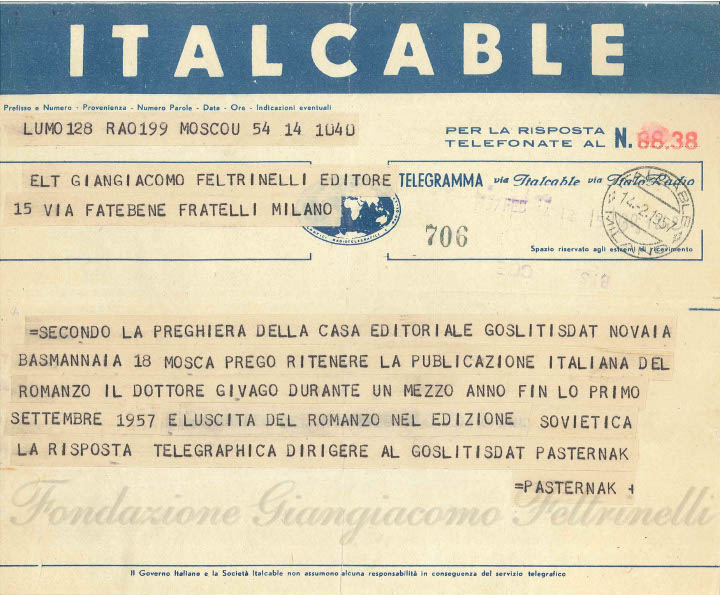
The first detail we need to address is the date of printing: September 2, 1957. In order to explain what is important about September 2, 1957, we need to go back to the cat and mouse game that the Soviet authorities were playing with Pasternak in order to forestall publication of the novel abroad. This convoluted story is recounted in detail in Mancosu 2013 but all we have to recall here is that the Soviet authorities proposed to Pasternak at the end of 1956 to publish with the State Publishing House [Goslitizdat] an edition of Doctor Zhivago that would be edited (doctored would be a more appropriate description) according to joint work between Goslidizdat and Pasternak. Indeed, a contract to this effect was signed by Goslitizdat and Pasternak on January 7, 1957. The intent of on the part of the Soviets was that of blocking Feltrinelli’s publishing plans for quite a while since Feltrinelli was hoping that a Soviet edition (in Russian) could be published before his translation into Italian and several other European languages for which he had a contract signed by Pasternak. In pursuit of this strategy, the Soviet authorities forced Pasternak to send on 13 February 1957 the following telegram to Feltrinelli:
15 via Fatebenefratelli Milano
According to the wish of the publisher Goslitizdat, Novaia Basmannaia 18, Moscow, please hold off on the Italian publication of the novel Doctor Zhivago for half a year until September 1, 1957 and the publication of the novel in the Soviet edition. Address your reply by telegram to Goslitizdat.
Pasternak (Cited from Mancosu 2013, p. 51)
Meanwhile, Pasternak had already sent a letter to Feltrinelli dated February 6 in which he explained what his real wishes were:
Moscow, February 6, 1957
Mr. Giangiacomo Feltrinelli editore,
15 via Fatebenefratelli, Milano
Dear Sir,
I am being pressed by the State Publishing House [Goslitizdat] to send you a telegram asking you to stop the Italian publication of my novel until it is published in a modified version by them. I would like to propose to you a maximum postponement of, say, six months. Grant this postponement, if it does not run against your views, and reply with a telegram not to me but rather to the address of the State Publishing House; Moscow, Novaia Basmannaia18, Goslitizdat. But the sadness that the imminent alteration of my text causes me, of course, would be much worsened if I were to learn that you would also like to follow it in your Italian translation, for this would go against my steadfast desire that your publication be strictly faithful to the authentic manuscript.[…]
All the best,
B. Pasternak (Cited from Mancosu 2013, p. 52)
The date September 1, 1957, is thus the date which Gozlidizdat has asked Feltrinelli to respect and by implication it indicates that by that date the Soviet edition would be published. And Feltrinelli took it that way because on February 28, 1957, he asked Pietro Zveteremich, the translator of Doctor Zhivago into Italian, to resume immediately work on the translation, indicating the necessity of be able to print by September 2!
Dear Zveteremich,
I am writing only to say that it is necessary to finish the Past.[ernak] within three months. The Russian edition comes out in September and in order for our contract to be valid, i.e. in order for us to be able to sell the rights, it is necessary that the book be on sale on September 2. I am willing to make some sacrifices, a compromise, provided that we can print by that date. Reassure me and make me some possible proposals. I touched upon the matter of the revision with Moravia but he did not seem enthusiastic. I will again speak about it with Bassani.
Meanwhile hurry up.
Very best,
Giangiacomo Feltrinelli
(AGFE, CP, busta 2, fascicolo 1; cited from Mancosu 2013, p. 48)
Thus, September 2 was the intended target date for the publication, at least judging from Pasternak’s telegram. In Mancosu 2013, I have described the legal situation with the copyright of books published in the Soviet Union. A Western publisher who managed to publish a translation of a book published in the Soviet Union within thirty days of its appearance in the USSR would ipso facto control the copyright. If a month passed without any translation being published, the book would fall in the common domain. Feltrinelli’s worries concerning the acquisition of the copyright emerge clearly in the following document by his lawyer Tesone who, on the very same date (February 28) on which Feltrinelli wrote to Zveteremich, wrote to Feltrinelli addressing some queries the latter had raised. The beginning of the document summarizes clearly the question that Feltrinelli had posed to Tesone:
Dear Mister Feltrinelli,
I have carefully examined the query you have submitted to me in the following terms: Whether the granting of the exclusive right of translation in favor of other publishers of Western Europe be lawfully valid, when the object of the contract is a hitherto unpublished work of an author resident in the USSR and for whom you have reserved, with a regular publishing contract, all the rights for the economic exploitation for all the other States in the Western World. In other words, you fear that the likely, nay imminent, Russian edition of said work [my emphasis, P.M.] and the initiative of the Soviet state publisher industry would imply, through the spreading of the work that would follow in the Western world, that the work would fall in the public domain on account of the fact that the author does not benefit from any international copyright protection. With the consequence that the contracts that you would meanwhile have concluded with the Western publishers with whom you are negotiating, would be practically meaningless.
(FGF, FoGF, fascicolo “Tesone”, 1.2.1.-b.19, fasc. 222.; cited from Mancosu 2013, p. 49)
In six dense pages, Tesone, one of the unsung heroes of the Zhivago story, argued that Feltrinelli could go ahead with his contracts:
It follows from what has been said that if the work of the Russian author, whose literary property you have reserved, will be published before or in any case not later than thirty days following the first Soviet edition, you will certainly be able to benefit from the international protection given by the Bern Convention. As a consequence, you will be able to validly negotiate with your Western colleagues the granting of exclusive rights of translation conditional on the happening of such an event and in any case according to the current probability that the event will take place.
(FGF, FoGF, fascicolo “Tesone”, 1.2.1.-b.19, fasc. 222; cited from Mancosu 2013, p. 49)
This then clearly explains the date September 2: Feltrinelli simply had to make sure that by the date Doctor Zhivago was published in the USSR, which the Soviets had indicated would be September 1, the Italian translation would be ready to appear. For this reason, he gave indications to Zveteremich to proceed at full steam with the translation.
The translation and the nature of the text that was printed in the Ur-Edition.
But getting the book ready for printing by the end of August turned out to be a real challenge. Zveteremich went back to work on the translation as soon as he received Feltrinelli’s request but the text was difficult and in addition it had to be prepared with other collaborators. As the translation proceeded, the text was being revised stylistically by Niccolò Gallo; additionally, Mario Socrate was assisting Zveteremich with the Zhivago poems. Furthermore, parts of the translation were also been sent for double checking to the editorial team in Milan.
On June 10, 1957, with Zveteremich’s translation just about finished, Feltrinelli replied to Goslitizdat expressing satisfaction for the imminent appearance of the book in the Soviet Union and confirming that he would not publish before September 1, 1957. But no one at this stage really knew what was going on with the novel in Moscow. Moreover, Pasternak wrote to Feltrinelli conveying his feeling that the novel would not appear in the USSR and that he was hoping Feltrinelli would publish on September 1:
Dear Sir,
I have been ill for more than three months, staying first at my place, then in the hospital, and now in a sanatorium close to Moscow. I thank you again for having granted to The State Publishing House (Goslitizdat) the postponement they had requested. However, this is truly all that I ask from you. All the rest is superfluous. If the work does not appear on September 1 by you in Italy according to the old Russian typescript, this will afflict me deeply and most bitterly. The delay of the Italian translation will create an obstacle for the appearance of the other foreign translations whose promoters (for instance in France, in England, in Czechoslovakia and elsewhere) I have always referred to you and put under your control.
The novel will never appear here. The troubles and the ordeals that perhaps will befall me in the case of publication of the foreign editions without the analogous publication of the Soviet one, all of this is not our business, neither yours nor mine. What concerns us is that the work appears, and that you lend me your help.
Affectionately yours,
B Pasternak (from Mancosu 2013, pp. 61-62)
But of course, Pasternak’s suspicions (although correct) could not be taken to definitely exclude the possibility of a publication by the Soviets by September 1. Feltrinelli was not to be taken by surprise.
Meanwhile a first draft of the translation was ready and on June 18, 1957, Zveteremich wrote to Feltrinelli:
Dear Feltrinelli,
I have finished the translation of Doctor Zhivago, including the poems, and in a few days I will send you the carbon copy by sending the first copy to Gallo, as it has already been done up to p. 546. I will send a copy of the poems to Socrate for a further revision sending you and the editorial team my first version for your benefit. In this way the hard but pleasant effort of the translation is coming to an end.
Zveteremich also reiterated his need to be able to reach Pasternak because some words were missing in the original typescript. He wrote:
I should write to P. [asternak] to ask him about a few unclear things including a question about a passage where, in the typescript of the original we have, there are some missing words. Do you have the address or how can we take care of this?
In order to finish this book I have given up the trip I had planned to make to the USSR in June postponing it to September. It was right to do so as I had committed myself to finish the translation and I am happy to have translated the book because it is a very beautiful book and it will be a great success. (AGFE, CP, Busta 2, Fascicolo 1.)
We will come back to Zveteremich’s trip to the Soviet Union in September but let us follow the destiny of the Italian translation for it will clarify the issue of the missing words. Despite Zveteremich’s promise to send in a few days the complete translation, things got complicated because the summer holidays arrived and communication among all the actors involved became complicated. So on August 7, Feltrinelli wrote to Zveteremich urging him to meet with Gallo to complete the work that had been left unfinished. On August 14, Zveteremich replied from Barcelona saying that he would be back in Rome on the 20th of August and that he would immediately meet with Gallo. Finally, on August 23, a letter to Gianpiero Brega of the Feltrinelli editorial team announced that the translation had been sent:
Dear Brega,
We have just sent the entire P.[asternak] translation after having resolved the last remaining issues. Gallo was happy about the translation and told me that he thought it had come out well; he liked the book very much.
In agreement with him we have decided to leave blank spaces where some quotations of religious texts should appear so as to insert them in the proofs after a more careful investigation of the Italian equivalent.
Also the notes will be added when we are correcting the proofs, which will not create any inconvenience.
In blank are also two words that ARE MISSING IN THE TEXT. I had already asked previously to send me Pasternak’s address in order to ask him about them but I never got a reply. How can we take care of this? I am leaving for Moscow (I am only waiting for the extension of the passport) [added in pen: I leave on the first few days of September and I come back after approximately twenty days], and I could perhaps send the missing words from there.
Moreover in blank is also the name of a grass (Ivan-caj) that no dictionary or Russian person consulted by me was able to clarify. Next week I will ask a Russian botanist and I will tell you what it is.
And for the poems what do you think you will do? I have not yet been able to see Socrate who was working on them. (AGFE, CP, Busta 2, Fascicolo 1.)
This letter explains a great deal about the Ur-Edition. It transpires from it that on August 23, one week before leaving for the Soviet Union, Zveteremich had sent to Milan the entire text of the translation but apparently not the poems on which Socrate was still working. Moreover, he explained why some things in the translation were left blank: religious citations, missing words from the typescript, and the name of a grass. In addition, (the majority of) the notes would still have to be added.
When we look at the Ur-Edition we see that the places that had blanks in the typescript Zveteremich had sent are replaced by “standard” or iterations such as “Standard, standard, standard”, The first example of such a replacement we have already seen looking in detail at the first page of the text (“La terra del Signore e la sua creazione” is replaced by “Standard, standard, standard”). What about the two missing words? Here is a picture of the typescript Zveteremich was working with:
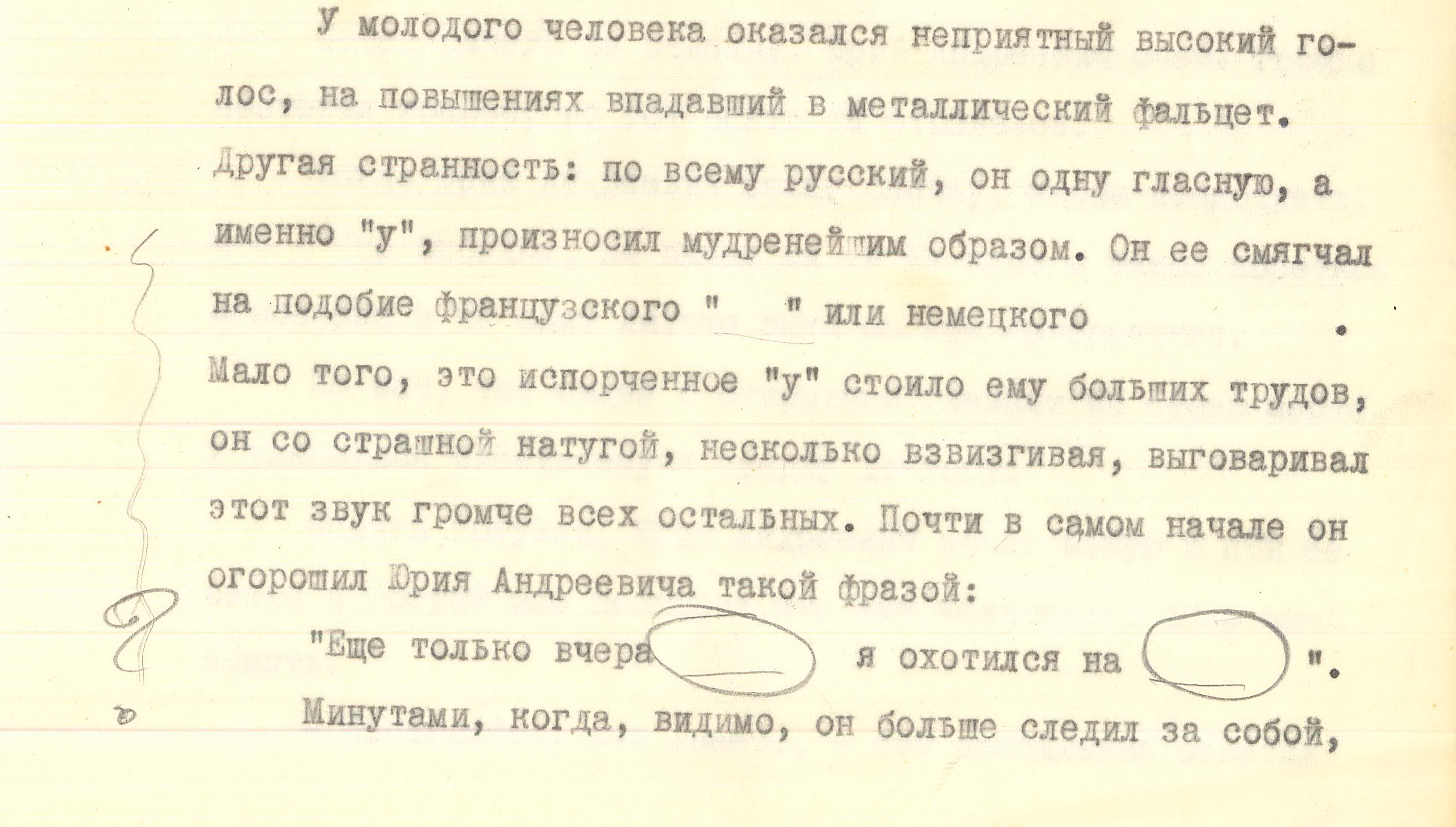
The question mark and the circling are by Zveteremich (notice that five lines above the circles there are two more missing words). The phrase in the first edition (p. 208) reads: “Ancora ieri mattina sono andato a caccia di anatre”. [Even yesterday morning I went hunting ducks] In the Ur-edition we read: “Ancor ieri standard sono andato a caccia standard” [Even yesterday standard I went hunting standard]
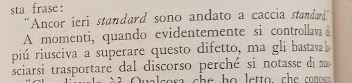
We also have an explanation for why the Ur-Edition has only some of the footnotes and placeholders for many footnotes are indicated by an apex in the main text with an apex in footnote position but empty text. There is an exception: on p. 8 the first footnote is there but not in a final form. In the Ur-Edition it reads: “Diminutivo di Furij [sic] (Giorgio)”; the in first edition: “Diminutivo di Jurij (Giorgio)”.
We now need to explain why the editorial note by Feltrinelli is not there. But this is easily done. When Zveteremich traveled to Moscow in September he was able to get information from Pasternak (through Olga Ivinskaya) as to his desire that an editorial notice should preface the Italian edition and Pasternak (through Ivinskaya) basically dictated the contents to Zveteremich. This information reached Feltrinelli through a letter from Zveteremich written on October 5, 1957:
Pasternak, for his own protection and so that things will be clear, suggests to prefix to the book a foreword by the publisher along the following lines: “This book was completed more than three years ago. Soviet radio and the journal Znamia (N.4, 1957 [[should be 1954, PM]]) have announced its imminent publication. Other announcements of a similar kind have been published in the Soviet press. As a consequence, our publishing house, knowing the significance of the author, took care to secure the publication rights, knowing well that otherwise, since Soviet books are not protected by the international convention on copyright, the work could have been arbitrarily translated and published by unscrupulous publishers. We received a copy of the manuscript from the author, and it received a more than favorable evaluation by our reviewers. We have thus commissioned the translation of the book, persuaded that this would not only do credit to the author but to the literary world to which he belongs as well. Regarding the preparation of the Italian edition there was later an epistolary exchange between our publishing house and the Soviet publishing house…(here insert a remark about their request for a delay, etc.). At the end of this past summer, when the composition of the book was already underway and nothing, neither from our correspondence with the Soviet publisher nor from the Soviet press, allowed one to foresee that complications concerning the publication might arise, we received a telegram from the author in which … (or perhaps quote the text of the telegram). The translator of the book has received an identical telegram and later a letter with the same content [[the last sentence is circled and Zveteremich adds in the margin: “This if you deem it appropriate”]]. Even if we had been able to agree with the author that the work is unfinished and is in need of serious development, we would have found ourselves, at this point in time, unable to stop the publication not only for technical reasons but also because, according to our agreement with the author, the rights for the work had already been assigned to other publishers in other European countries. But we are persuaded that the book, just as we are publishing it, far from being unfinished, represents, on the contrary, a work of exceptional significance, and it is with this conviction that we have printed it and present it to the Italian readers. (Here, if you deem it appropriate, add that an author is quite often uncertain about his own work and that your publishing house thinks it is doing him a favor, while on the other hand an author, once the rights of a work handed over in a certain shape have been granted, does not have the right to introduce substantial alterations).We would moreover add that we are not averse to thinking that these repentances and uncertainties of the author might have been to a great extent roused by the attitude perhaps taken towards his work by certain Soviet literary personalities who are more bound to conceptions of art that are dogmatic and outright functionalistic in a political sense”.
Of course, I have jotted down this foreword just as Pasternak had conveyed it orally to me [through Olga Ivinskaya, P.M.]. One must now rephrase it correctly respecting the intended meaning. (Cited from Mancosu 2013, pp. 239-240)
The editorial notice follows closely the above text and was ready by October 24. Indeed, on that date Feltrinelli sends a copy of it to Kurt Wolff (“I am also sending you a copy of the foreward [sic] I am publishing and which also may be quoted”) and on October 25 to Sarah Collins (“I am also enclosing the foreward [sic] I will publish in the Italian edition of “Doktor Zivago”.) (Both letters cited in Mancosu 2103, p. 91)
It is thus clear from all these elements that the Ur-Edition represent the state of the text as it was delivered by Zveteremich at the end of August. This explains the lack of most of the footnotes, of the editorial preface, and of the poems. Moreover, it explains the strange insertion of “standard” which simply served as a placeholder for things that had to be fixed in a final revision of the translation. But for all its incompleteness this printed text dated September 2, 1957, could have been displayed to claim copyright by Feltrinelli in case the Soviets had published by September 1, something which might still have happened for anything Feltrinelli or anyone in the West knew in August 1957. Only after Zveteremich reported in early October to Feltrinelli about his September trip to Moscow, it became clear that the Soviets had decided not to publish the book. So, the Ur-Edition did not serve the same pressing need and could be improved upon. The first edition is the result of the changes made to the Ur-Edition in September and October 1957 not only in the above listed areas left pending by Zveteremich but also in the final effort to smooth the text and improve its style. On October 3, 1957, Riva wrote to Zveteremich:
Dear Zvete,
I include the list of the missing notes; as you see there are quite a few of them. I hope it will be clear to you. You also know that we are very pressed for time, for otherwise we cannot print the book. I am planning by tomorrow or Saturday at the latest to have finished reading and revising the proofs; every now and then problems come up that are not easily solved; in case, I will call you and we will try to solve them together. […] p.s. I am anxious to receive news of your trip in the USSR (AGFE, CP, Busta 2, Fascicolo 1.)
The printing date of the first edition is November 15 but it was put on sale on November 22, 1957.
This then is the story behind this very rare edition. It should be mentioned that Zveteremich seems not to have not known about it (if he did, there is no documentary evidence that I was able to find witnessing this). Indeed, in a letter to Feltrinelli dated 15 December 1957, Zveteremich complained that he had not received copies of the published book (meaning the edition that was published on November 15). Moreover, it is uncertain whether anyone in Feltrinelli’s editorial team had been informed of the printing of the book in early September.
One final word about the origin of this copy of the Ur-Edition. Giacomo Coronelli ahs informed me that this copy of the Ur-Edition, which is the only one to have surfaced so far, originates from the library of the Italian journalist Camilla Cederna. Since Cederna met Feltrinelli in the early 1960, this excludes -with very high probability– that she came to own the copy before the early sixties, for at that time was not part of Feltrinelli’s inner circle (see Cederna 1980, p.243). However, her later friendship with Giangiacomo and Inge Feltrinelli (see Cederna 1980) might explain how she came to own the copy.
Bibliography
Archivio Giangiacomo Feltrinelli Editore (AGFE), Milan
Cederna, Camilla, 1980, Il Mondo di Camilla, Feltrinelli, Milan.
Mancosu, Paolo, 2013, Inside the Zhivago Storm, Feltrinelli, Milan.
Acknowledgements. I would like to thank Giacomo Coronelli, Lucia Di Maio, and Giovanni Milani for their help and support. A special thank to Carlo Feltrinelli for having granted permission to use the sources quoted (or reproduced) above from the Archivio Giangiacomo Feltrinelli Editore, Milan.

